Showing posts with label Multiplayer. Show all posts

Tuesday, March 14, 2023

Welcome Aboard Commander

Carrier Command 2 is not only a sequel to the 1988 original, but a return to form after the failed 2012 soft reboot Carrier Command: Gaea Mission.  Nowhere is this more apparent than the visuals.  Gaea Mission attempted to go with a semi-realistic near-future look while the direct sequel is a mix of voxel shapes and pixel textures that feel like a natural evolution of the original game.  

At heart, the Carrier Command series is a RTS/FPS hybrid.  The games create a simulacrum of actual carrier operations.  The big caveat being air, sea or amphibious operations are carried out by drones which are controlled remotely via camera links.  Alternatively, the player can issue instructions on a tactical display which the drones will then carry out semi-anonymously.  Ideally, a mixture of both is how the game is meant to be played.  While it is certainly possible to tour much of the titular carrier through the player's in-game character, most (if not all) the game will be experienced on the bridge.  In this room, there a nine stations (three for drone control, one for the helm, one for shipboard weapons, two for managing logistics, one for power/coms, and the captain's chair).  It's certainly possible to play solo though a lot of multi-tasking is required to achieve any degree of success.  That said, I can't see there really being a need for more than three or four players aboard a carrier.  The game allows up to 16 which can participate in PvE or PvP style matches.

Aside from destroying all enemy carriers, the main task which players will be focused on is capturing islands.  Unsurprisingly, the world is an archipelago consisting of (a default) 64 islands, each procedurally generated and defended by computer-controlled vehicles.  A shield rating system (from 1 to 4) indicates how heavily defended a particular island is.  As far as I can tell one-shield islands are guarded by lightly armed land vehicles only, while two shields means they have either air or sea units present.  Three means both of those are deployed in addition to turret and missile defenses.  As for four...well, let's just say they are tough nuts to crack.  Each island also has its own biome (volcanic, tropical, forest, desert or snow-covered) and manufacturing focus (fuel, small munitions, large munitions, air chassis, ground chassis, support equipment or supply barges).  Once captured, the player's team can use the island's facilities to produce some of what they need to keep up their war efforts.  The logistics aspect of the game is actually fairly important to the point that it can occupy a lot the downtime that occurs when traveling between islands.  Another island type of note is the player's starting one.  It's a stockpile hub, but more importantly has a shipyard capable of launching small single-purpose gunboats.  These are handy to have, but also completely dependent on the carrier for fuel and ammunition.  Overall, the vibe I got was one similar to Homeworld: Deserts of Kharak.  So while Carrier Command 2 has a FPS perspective, it's really only there for emersion purposes.  The player can leave the carrier if they want, go swim in the sea or even walk around the various islands in the game, but there isn't any reason to do so.  Unlike Gaea Mission, there are no personal firearms or man-portable weaponry to be had.  The player can only attack through vehicle-mounted weapon systems.  Just to drive the point home, there is an option in the ESC menu that teleports the player back to the bridge regardless of where they wandered off to.  Welcome aboard commander!  Now that you are here you can never leave...well, at least until you win, lose, or quit to desktop.


Tuesday, February 21, 2023

Beaten to the Punch (Part 2 of 2)

Cover-based shooters were all the rage during the late 2000s and early 2010s.  The mechanic was popularized with the release of Gears of War in 2006, but had existed at least as far back as 1995 in the form of the arcade machine Time Crisis.  Granted, that was a light-gun game.  However, even if we were to limit the genre to third-person cover-based shooters there was kill.switch in 2003 and WinBack: Covert Operations in 1999.  Both of these titles have largely been forgotten to time compared to Gears of War, which has since gone on to become one of Microsoft's tentpole franchises (with four mainline sequels and several spinoff titles).  If I had to hazard a guess as to why, I'd say it has something to do with WinBack and kill.switch being more techno-thrillers and less Warhammer 40k adjacent.  I guess people really love guns that have their bayonet attachments replaced by chainsaws.

Angbad is one of those venerable ASCII roguelikes whose lineage can be traced back through Dungeons of Moria to the original Rogue.  As one might guess based on its name (and the name of its immediate predecessor), Angbad is heavily inspired by J.R.R. Tolkien's Middle-earth setting.  The player begins the game in a small town consisting of some shops and a few NPCs.  Bellow is a hundred floors of procedurally generated dungeons filled with monsters, traps and treasure.  At the bottom level is Morgoth, who must be defeated in order to win the game.  In other words, Angbad is basically Diablo without music, sound or graphics.  It even has the randomized loot drops and a color coating system that is practically the standard for games of these types.  It's also free-to-play, obviously, for copyright reasons.  Despite not having much in the way of monetization potential, Angbad has been in active development for over three decades with a surprisingly active mod making community.  Even so, it has been completely eclipsed by the Blizzard franchise that was inspired by it.

Saving the most unusual for last, we have Herzog Zwei.  German for "Duke Two", this Sega Genesis exclusive was the inspiration for not one, but two whole genres of video games - the RTS and the MOBA.  As the title is perhaps trying to imply, the game can be played either versus the CPU or via split screen.  Players only directly control a single transformable air/ground vehicle, but are able to build a number of other units to assist them in capturing key locations on the map.  These subservient units can be given simple orders, but generally require a lot of micromanagement to be effective.  Because the game is real-time this can lead to feelings of being overwhelmed.  It's a problem that prevented the game from achieving wide-spread appeal.  Regardless of that, Herzog Zwei is the grandfather of Total Annihilation and Supreme Commander, not to mention Dune II: Battle for Arrakis and Warcraft as well as the Command and Conquer series.  It even got a spiritual successor in the form of the free-to-play online-only game AirMech.  Despite recieveing this polished up re-imagining the original concept has never really attracted a large playerbase.

There are more games I could cover.  Meridian 59 (the first MMORPG to feature three-dimension environments) comes to mind, but I think I have written enough for now about humble trend setters.  It's also worth mentioning that one can always dig deeper.  Back at the beginning I mentioned Sweet Home being the starting point for the survival horror genre.  In truth though one could go back further to Project Firestart in 1989 or even Haunted House way back in 1982 (for the Atari 2600) and claim that either of them is where it all really got started.  Of course that can lead to very reductive statements like "all games are based on the first distributed game ever - Space War!"  Tempting to declare, I'm sure, but the fact of the matter is game designers are influenced by things outside the realm of video games too.  The same holds true for other kinds of media as well.  One could claim that the 1982 film TRON was inspired by electronic entertainment, but if you sit down and watch the movie you'll gradually realize that it was based on Frisbee, handball, tennis and motorcycle racing as much as Pacman or Pong.      

Tuesday, November 1, 2022

A Day Late and a Dollar Short

Kerbal Space Program 2 (abbreviated as "KSP2") is coming out...seriously this time.  After being delayed over and over, from 2020 to 2023, it now has a set launch date of February 24th.  There's just one catch though - it's early access.

Normally I wouldn't have a problem with this except the price tag is just shy of what full retail titles cost.  That's a lot for a game that doesn't have a campaign mode, base building, interstellar travel, multiplayer, or any of the other features implemented yet that would make KSP2 a proper sequel.

Well, surely the graphics are a big improvement over the original, right?  Not exactly...with the Parallax 2.0 mod coming out for the original KSP soon, the difference is a lot slimmer than one might expect.  Granted KSP2 may have some under-the-hood improvements (such as code optimization, better UI, and a true banishment of the dreaded physics kraken), but I'm not believing it until I see it.  That high degree of skepticism might seem unduly harsh.  However, keep in mind the dev team has gone on record in interviews incorrectly claiming that time warping while under acceleration is a new feature.  In fact, it was possible in the original KSP up to a "x4" increase.  As discouraging as all this is, I might be willing to overlook these failings if not for a rather huge misstep early on in KSP2's development.

The original team behind KSP2 consisted of a studio called Star Theory Games.  For reasons that remain nebulous, the publisher, Take Two, cut funding which in turn caused the developers to go belly up.  Take Two then immediately poached a bunch of the studio's former employees with the allured of a new job and sign-on bonuses.  Essentially, it allowed Take Two to move the entire operation in-house while simultaneously purging anyone they didn't see eye-to-eye with.  It's about as sleazy as business practices get, plus it was done by a corporation with a (let's just say) less-then-stellar reputation...not that the original inventor of KSP, Squad, was all that great either.  Recently it came light that they apparently paid their employees very poorly even by Mexican standards.  No wonder the programming work on that game was such a hack job.

Sorry little Kerbals.  You guys might be adorable, but your creators have all the flaws of Greek gods and none of the splendor.    

Sunday, January 23, 2022

Visual Dissonance

GTFO is a four-player co-op FPS.  It's also extremely difficult.  The tagline for the game is "work together or die together," but based on personal experience working as a team can still end in disaster.  There are, of course, ways to limit the risk.  Creating choke points, going stealthy, or simply avoiding places inconsequential to the mission are some methods that can be employed.  However, this particular blogpost isn't about all that.  Instead, I want to indulge in a bit of introspection by comparing GTFO to another title.  It's a little game about danger, darkness and dwarves...

Deep Rock Galactic has an uncanny number of similarities to GTFO.  Like that game, it is a four-player co-op FPS.  Also like GTFO, each mission consists of delving into a procedurally-generated subterranean maze of poorly illuminated tunnels and chambers with the express goal of completing a specific objective.  If I had to point out a big difference between the two, it would be the visuals.  GTFO is a very gloomy looking game.  Player characters have realistic physical proportions (not to mention psychological tolerances), and the general feel is akin to a wide-awake nightmare.  Conversely, Deep Rock Galactic is far more colorful with player characters of somewhat cartoonish proportions (understandably so considering they are supposed to be everyone's favorite bearded race of beer guzzling little people).  Overall, the look is World of Warcraft in space.  Whereas GTFO takes its cryptic storytelling very seriously, Deep Rock Galactic has a lot of comical cynicism, as well as bits of levity sprinkled into what would otherwise be a very grim situation to find oneself in.

Taking all this into account, along with the fact that GTFO is still in early access, Deep Rock Galactic seems like the obvious choice for people interested in playing a game of this particular subgenre...and yet, I find myself leaning toward GTFO.  I was entrenched by similar circumstances concerning Halo and Killzone many years ago.  With regards to the quality of moment-to-moment gameplay, Halo is the superior franchise.  That said, I spent far more time in those days playing Killzone.  Compared to the dreary battlefields of that game, Halo is a riot of color.  Like Killzone, Halo has a fairly grim narrative and it's here that I think I have found the reason for my odd tastes in video games.  For me, the mood of the story needs be reflected in the visuals.  In games like Deep Rock Galactic or the Halo series, I get hit by a form of tonal whiplash...and not in a good way.

I should end this by stressing that I have no prejudice toward bright and colorful games.  Two of my favorite games on the PS3 were Flower and the original Valkyria Chronicles.  More recently, I played Subnautica on the PS4 and enjoyed that game's aesthetic quite a bit too.  It's important to note though the prominent themes in those games are hope, nostalgia and mystery...but not the constant feeling of impending doom.  If you happen to be a game designer and are reading this my suggestion would be make sure your artists are on the same page as your story writers, if for no other reason than consistency's sake.   

Thursday, June 24, 2021

Game Preservation

I was recently watching a video about the sound modulation used to voice the robotic Cylons in the original Battlestar Galactica.  As it turns out, the technique was lost to time and had to be reverse engineered by means of digital post-processing mixed with some antique electronics that were cutting edge when the TV miniseries was in production.  The end result was a very close approximation rather than a precise match, overall, the entire endeavor served to illustrate how painstaking it can be to reconstruct something if the method for making the original is forgotten.  When people talk about preservation, especially with regards to skillsets, I feel like they really just want to save on a whole lot of effort somewhere down the line when some as-of-yet-unborn historian or wants to know how his or her predecessors did it.

Worse still are techniques that have not only been erased, but the products are also irrecoverable.  The burning of the Library of Alexandra marked the loss of countless books only known to exist because they are mentioned in other works that managed to survive down through the ages to the present day.  Marie Empress was one of the biggest stars in pre-WW1 Hollywood before vanishing without a trace.  What's more shocking though is the fact that not a single movie she appeared in still exists.  Like so many silver screen films, they have all been deliberately destroyed or eroded into nothingness due neglect.

Presented with these harsh facts, I feel like it isn't really all that difficult to understand why some people have strong feelings toward video game preservation.  Batteries die, circuits fail, monitors burnout, controllers break...it's an inevitable side-effect of age and use, particularly when a lot of these devices were never built to last.  Making digital downloads version of old titles is an optional solution, but requires emulation and, if truth be told a CRT monitor.  There is only one company left that makes these antiquated displays, but they are what old games were designed to be played on and as such the graphics don't match quite right on modern HDTVs.

Of course, all this is peanuts compared to the biggest issue of all.  Companies, either due to neglect or deliberate distain, will ensure their games eventually arrive at an unplayable state. Typically, these sorts of titles are MMORPGs or other games that require an online connection, while simultaneously lacking dedicated server support.  An incomplete list of titles at risk, dead or saved is available here (link).  I should mention that some of these games aren't very good (at least as far as aggravated review scores go), but it's still sad to think that with a little effort from the developers "dead games" wouldn't be a concern.

Another very weird case is games that have received so many updates and patches they only vaguely resemble what they once were.  Stellaris, as of Spring 2021, is almost an entirely different game compared to what it was several years ago at launch.  The same goes for No Man's Sky and Oxygen Not Included.  There was a time when the star voice actor for Destiny was Peter Dinklage.  Now he's nowhere to be heard.  In some games (such as Minecraft) it's possible to revert to older versions fairly easily, but most titles don't receive that amount of support.

So, what all this really comes down to is every single one of these kinds of games needs an end-of-life plan.  What that entails exactly can differ depending on the circumstances.  In one case it might involve releasing the source code, in another it could mean making the game shareware.  Ideally, developers need to put out a final version of the game that allows people who purchased the game to continue to have the ability to play it.  Some people might claim that publishers are just engaging in a bit of double-dipping in the hopes of selling the same game to the same customers (just on a different platform), but as Sony's attempt to kill their PS3 shop on the PSN has shown it's not even about that.  Is it laziness?...Greed?...a simple lack of foresight?...I don't know for sure, but I can say with complete confidence that it comes from a lack of respect for the art form.  Humanity has already made this mistake at least twice before with literature and film.  How about we not make the same mistake a third time with video games?         

Monday, May 3, 2021

Satis-Factory-Oh

Factory construction sims are a pretty niche genre and yet there are two separate IPs currently in development that fit the definition perfectly.  The first is Factorio.  With a Steam early access release in 2016, this Czechoslovakian title has since become "complete" as of August 2020.  I put complete in quotes because even though the game has passed the version 1.0 mark it remains in active development.  Regardless, I imagine that any new official content will come in the form of paid DLC.  The other title is Satisfactory.  Made by the same developer as Goat Simulator, this game is newer (having launched in early access on the 19th of March, 2019) and is not yet feature complete despite just recently receiving its fourth major update.  Anyway...that little development overview aside, what's different about these two games?  Depending on who you ask, the answer can vary from "not much" to "quite a bit."

On first impression, players will immediately notice Factorio is a 2D sprite-based game viewed from an isometric perspective.  It's highly optimized and runs smoothly even on fairly old hardware.  It's perfectly functional, but not especially pretty to look at.  Satisfactory, on the other hand, utilizes fully three dimensional environments viewed from a first-person perspective.  Everything is more impressive visually, but the GPU demands can lead to performance issues even on newer gaming machines.  This is especially true when the number of objects onscreen get large.  Visuals aside though, what's different when it comes to gameplay?

When beginning a new game, Factorio allows the player to specify what kind of world the procedural generator should create.  It's a nice feature to have, but only really makes changes to topography and resource distribution.  Regardless of the settings, the player will find themselves in a relatively flat, arid location with patches of trees, water and minerals.  Conversely, Satisfactory has four biomes to choose from at the beginning, each with their own distinct qualities.  While a more exciting way to start off, it's important to note that there is only one handcrafted world - the player simply chooses where they get dropped into.  Given it's 3D nature, Satisfactory is much more vertically oriented.  Exploration is also a more prominent feature.  To Factorio's credit though, it has one major feature that is absent in Satisfactory - base defense.

Both games feature hostile fauna on their respective alien worlds, but Factorio takes it to another level.  Specifically, there are hostile colonies of giant insects that will encroach on and attack the player's base(s).  Apparently, these bugs really hate pollution and will seek to destroy anything that does not conform to nature.  Of course, this gameplay feature can be tweaked or outright disabled during world creation.  Nevertheless, it remains a fundamental component of the intended experience.  Everything from laser turrets and artillery pieces to flamethrowers and tanks can be built to deal with external threats.  Conversely, Satisfactory has far fewer weapons and, in general, is a much less intense game.  

I've tried to clarify some of the differences, but when you get down to it both of these titles have resource extractors, smelters, power generators, automation and a whole lot of conveyer belts.  They both take place on exoplanets.  Either can be played multiplayer or alone.  Currently Factorio has a lot of mod support on the developer's website, but there are plans to introduce mods into Satisfactory via Steam Workshop.  If you're wondering which to buy, I would say get both.  Together they cost less than your average triple-AAA title, and you'll probably get more hours of enjoyment out of them as well. 

Friday, December 11, 2020

Free and Worth Every Penny

In a relatively recent interview, acclaimed movie director Francis Ford Coppola mentioned that two of his most highly regarded films, "The Godfather" and "Apocalypses Now", were largely panned by critics in pre-release screenings.  In hindsight this all seems rather absurd.  Both motion pictures are currently considered some of the very best in 1970s cinema.  Conversely, look at what has won an Oscar for best film over the years.  Does anyone really hold "Driving Miss Daisy" or "Crash" in high regards these days?  The video game industry is no exception to this phenomenon either.  Giant Bomb's 2017 game of the year was PUBG, a FPS that was even then in the process of being overshadowed by other battle royale games.  Meanwhile, GameSpot is the only major outlet that has ever given a game-of-the-year award to a Souls-series game, despite the immense influence they've had on game design.  So, what I'm I getting at here?  Well...early criticism (particularly in the form of video game reviews) doesn't have much value even if it's coming from a profession source.

This is especially true when one considers early access titles or games that receive considerable post-launch support.  Pretty much any review (written or recorded) will inevitably end up out-of-date at some point in the future.  Generally speaking, patches and content updates improve the quality of a game, but not always.   Trackmania is somewhat famous for being noticeable worse in it's final form than it was earlier on.  Whether it be pre-release hype or restrictive NDA's, attendees of sneak-peeks or preview events have a troubling tendency to be of the enthusiast press variety.  In other words, it's glowing praise or nothing at all.  Of course, once the game is out in the wild, so to speak, the truth becomes known.  Sometimes it more or less affirms early impressions, but oftentimes that's not the case.  Regardless, down-the-road reviews tend to be deeper and more thoughtful in their analysis by virtue of taking the necessary time to digest what was consumed.  That's not to say that later, slower, and longer always equate to better criticism though.

It only takes a few minutes of browsing through an aggregated review website to find a recent review of an older game that is a bunch of poorly thought out garbage.  So, how can we seek out good criticism?  The unfortunately reality is forming a consensus takes time in much the same way one must wait for the cream to rise to the top of a glass of fresh milk.  That said, the thing that I think benefits critical discussions of video games the most is a wide variety of differing perspectives.  Obviously, the pitfall here is critics who are blind to their own biases or lack the empathy to relate to someone coming from a different view point.  This sort of thing is what leads to petty arguments rather than genuine debates. 

So, am I saying that reviews are trash?...kind of...yeah.  If you can find someone who has similar tastes to your own then that might be valuable, but could potentially lead to merely seeking validation over actual merit.  I strongly believe that only through hearing out differing opinions can one truly experience a piece of media to the fullest.  Alternatively, there are a number of streaming and video-on-demand services out there that let us see and to some degree judge a game for ourselves without actually playing or paying for it.  This isn't a perfect solution though, in that it's time consuming and (for better or worse) any particular part of a game may not be indicative of the overall experience.  Simply put, there are games that peter out after the first act, and there are games that take ten or more hours to really get going.

I guess in the end there aren't any perfect solutions to the problems associated with video game criticism.  Ultimately the best thing any of us can do is to stay one step behind the curve.  Given how FOMO driven gaming is these days though I feel like that strategy is only viable for someone who carefully avoids spoilers, has iron willpower, and doesn't mind only participating in LttP style discussions.  No matter what kind of person you are though, I have one piece of advice I hope you'll take to heart: 

Never trust a day one review of anything.

At best it will be ill-informed, and at worst a blatant attempt to cash-in on whatever the current zeitgeist is.        

Tuesday, September 3, 2019

KSP2

The orientation of Duna in this picture is all wrong
It should be shaded vertically, not horizontally
Some new titles were announced at Gamescom 2019, but the only one that stood out to me was Kerbal Space Program 2.  It's great that this spaceflight-sim is finally getting a sequel (even if it isn't the original design team that is working on the game).  Based on the limited information that is currently available it sounds like this will be truly sequential in that it will be adding new technological advancements, as well as expanding the scope to include interstellar exploration.  However, there are a few worrying inaccuracies in the trailer...and also some aspects of the game that remain unaddressed despite being vital components of the experience.  Let's start with the good stuff.

The thing that I think everyone will notice right off the bat is all the graphical enhancements made to the rendering engine.  I'm not talking about the trailer.  That is entirely made up of pre-rendered cutscenes.  Rather, what I'm talking about is the short clips that we've seen thus far of gameplay.  Surprisingly,  KSP2 is using Unity once again.  Considering the scale of the game though I wonder if the developers had to write a bunch of custom code in order to make the time and distance scales that the game deals in manageable.  Regardless, it's nice to see all the classic parts making a comeback, along with old Kerbonaut favorites like Bob and Valentine.  As for new things...wow...as far as I can tell there are some really impressive pieces of hardware such as the Project Orion and Daedalus spacecrafts, as well as a VASIMR drive.  It's a bit more sci-fi than the original game, but I like it because it feels like a natural evolution for KSP.  Now for the more troubling stuff.

Good on the developers for showing the rocket buring retrograde here
But I don't think a ringed world and moon could be that close  
Scott Manley very astutely pointed out a few scientific inaccuracies which I have relayed in the picture captions attached to this blogpost.  They aren't deal breakers, and for all I know they might have been done intentionally in order to create more spectacular visuals.  Either way though, I hope they are fixed by the time the game launches.  Those matters aside, the real make-or-break feature here is the way the development team decides to tackle research and missions.  Back when the original KSP was still in early access Squad (the original developers) introduced a "career mode" which utilized three currencies called science, funds and reputation.  It was a neat idea on paper, but in practice proved to be both boring and unrealistic (with regards to how space agencies actually operate).  When you get down to it all human endeavors involving outer space amount to three things:

  • Advancement of Scientific Understanding
  • Achievements in Human Spaceflight
  • Improving Infrastructure for Profit

Any human designed mission is going to be one, two or all three of these things.  So, I don't see why it needs to be any different for Kerbals.  That might sound bland, but if done correctly I think it might be possible to provide players with a dynamic mission tree that fosters a compelling single-player campaign.  Whatever they end up doing though it shouldn't be reduced to the level of "get points so you can get more points."  If I wanted that kind of experience I would play a cookie clicker instead. Obviously, sandbox mode can still be an option in addition to being an excellent stepping stone into multiplayer (a feature already announced for KSP2).  I just hope sandbox mode isn't the only way to play the game at launch.  For a 60 dollar retail product, I expect there to be a bit more to this one the the original.

Thursday, August 22, 2019

All Because of an Axe

Respawn Entertainment (makers of Titanfall) released a game a little while back called Apex Legends.  It's one of those Free-to-play multiplayer titles capitalizing on the battle royale craze that is sweeping the online shooter market.  By most accounts it's a good example of the sub-genre, but there has been one big catch; the parent company of Respawn is none other than Electronic Arts.

Yup...EA, the video game publishing company that has become the embodiment of bad business practices is pulling the strings.  So, unsurprisingly after reviews had come out praising the game, the dev team decided to introduce an "event" involving pricey cosmetic DLC sold via loot boxes.  Introducing "surprise mechanics" in video games still seems to be EA's modus operandi despite all the controversy and backlash surrounding this particular monetization scheme.  Predictably, there has been a lot of community friction recently.  To say things have become ugly would be an understatement, I think.  What caught me off guard though was the development team's reaction.  After trying the "we're sorry (but not really)" approach certain employees at Respawn decided to vent their wrath on customers.  Basically, the counterattack headed by the community manager and project leader has been spearheaded by claims that the player base is being overly hostile and abusive.

It's accurate to a degree, but doesn't address the fundamental issue - exploitative  monetization practices.  Complaining about socially inept basement-dwellers being mean on twitter or reddit feels suspiciously like an attempt to deflect criticism and draw the discussion away from what started the problem to begin with.  It's also worth mentioning that some of these toxic elements are teenagers who are irate because they are being psychologically manipulated.  Are these kids being articulate when it comes to expressing frustration with being treated like idiot cash-cows?  In many cases certainly not, but in their defense they're not adults.  On the other hand, I'm pretty sure everyone working at Respawn and EA is in their 20s and 30s (if not older).  Yet, some these people who hold positions of power in a multimillion dollar corporation sink to the level of irate children when called out on their scummy behavior.  It's a sad state in that the opportunity for a grown-up conversation has been lost because of all the temper tantrums.  Sign of the times, I guess...

Of course Vince Zampella (the president of Respawn) eventually did step in and attempted to clear the air with an apology message...which failed to address the fundamental issue of quasi-gambling in-game microtransactions in any way shape or form.  Instead, the discorse is entirely framed around who's the victim here - gamers or game creators.  The truth is both are...at the hands of triple-AAA publishers like EA. 

Friday, March 1, 2019

Amusement Park of Illusions

Want to go on another ride?
You won't have to wait in line,
but you will have to sit through loading screens.
...many, many loading screens.
I was thinking about Anthem and how it not only represents a step backwards for Bioware, but video games as a whole in a lot of ways.  I'm not just talking in terms of storytelling here, but also gameplay.  It seems the general consensus is the action in Anthem doesn't even hold up to Mass Effect: Andromeda - a game which, itself, was not well regarded.  Exploration, too, seems pretty basic in that the world of Anthem amounts to a large surface area with little underground (or underwater) places to investigate.  Sounds fine...except when you think about it, isn't that really just the original Legend of Zelda for the NES all over again?  RPG elements also somehow manage to be inferior to 8-bit Final Fantasy in that there's no way to view character stats.  What has changed dramatically is the presentation.  Everything looks and sounds impressive at first glance.  However, upon closer inspection it becomes obvious that all the glamour is hollow, paper thin, and completely lacking in substance.

When you look back at games like the Worms series, Red Faction 2 (and Gorilla), or even Minecraft there were genuine attempts to allow the player to make a mark on the world; specifically environmental deformation.  More recently, games like From Dust, Metal Gear Rising and Astroneer have taken small steps toward improving on the concept, but when it comes to live service games (with the possible exception of Fortnite) the design is noticeably regressive.  Every object and surface in the world is indestructible and enemies themselves are just bags of hit points that burst into non-existence once their damage numbers reach a predetermined threshold, only to later reform out of the ether much like a Disneyland ride that has just been reset in preparation for the next visitor.  There's no persistency, no such thing as injuries, crippling battle damage, or scaring; there are no thoughts of retreat or escape.  Things exist or they don't exist, and on top of all that the AI only seems to have two settings idle about or attack...basically everything has a switch with two setting: off or on.

The expression "wide as the sea, shallow as a puddle," is usually applied to content in video games, but in Anthem that can literally be applied to everything including the Javelin that the player controls.  I'm not talking about a lack of character development (although that is an issue), rather I mean where is the power plant, actuators, shield generator, sensors, communications equipment or weapons systems?  None of these components are represented in the mechanics of the game aside from flight thrusters which can sometimes be disabled temporarily (usually for mission scripting reasons).  The pilot, for all intents and purposes, is impervious to harm.  Even cosmetic damage like scorch marks, slagged armor, leaking coolant and sparking wires are completely absent from the visual presentation.  Sure, there's pyrotechnics and a cacophony whenever a fight breaks out, but that's it.  It's like if a motocross bike did a couple of laps on a race track yet didn't get a single drop of mud on it.

To some degree these sort of things are limitations any video game must wrestle with.  I don't need to explain why "personalized story" and "multiplayer adventure" are mutually exclusive, right?..and yet live service games will claim that it's possible to have your cake and eat it too.  It can be frustrating to hear complaints like "I wish I could grapple enemies," or "my melee attacks contect like a bar of wet soap."  I want to tell such individuals that this is the inevitable result of games that depend on netcode...at least for companies that want to minimize bandwidth usage.  Would games like Anthem (or Destiny, for that matter) have been better had they gone the single-player offline route?  I don't know (it depends on how much you enjoy playing with friends online), but the potential for a more substantive experience would have certainly been there.  On the other hand if it's a live service, you are pretty much guaranteed to get something shallow, half-baked, and filled with microtransactions.

Tuesday, March 6, 2018

Two Pronged Attack

"It's the 90s all over again!" when it comes to video games and government legislation.  In the wake of recent school shootings the president of the United States wants to (maybe?) have a meeting with the ESA to discuss violence in video games and the potentially negative impact it's having on the youth of today.  Coming from the opposite direction is a grassroots push to get loot boxes and other quasi-forms of gambling mechanics out of mainstream gaming.  Should enthusiasts of this beloved hobby of ours be concerned?...eh, yes and no.

If you asked me ten years ago about what the World Health Organization is calling "gaming addiction" I would have told you it's a load of crap.  However, given the direction over the last decade or so of publishers going out of their way to introduce psychologically researched methods of manipulating players out of their money, it's not hard to see how some people might get hooked into becoming a "whale."  I still think that the underlying vulnerability to these sorts of predatory practices is caused by issues such as OCD or depression.  Treating that fundamental problem should be the overriding priority since gaming addiction is at worst a symptom of a much larger concern.  Additionally, there are still a lot of games that do not deal in micro-transaction based revenue streams.  The vast majority of games with "addictive" mechanics are MOBAs, MMORPGs, competitive online shooters, and free-to-pay (not a typo) mobile games.  If you are like me and not really into any of these particular sub-genres then I'd say you're relatively safe.  The thing is companies like WB interactive, EA, and Activision are pushing hard to turn the industry into nothing but these sorts of games; all branded under the "live services" PR label.  Speaking as someone who enjoys single-player narrative-driven experiences, I can't say I have been very happy with the direction the industry is going in for a long time now.  Does that mean that I welcome government regulation?...not really, but what other recourse do we have?

Boycotts have proven to be notoriously ineffective.  The ESRB/ESA are as corrupt and useless as the teamsters union cercia World War II.  FYI, did you know that the ESRB doesn't actually vet any of the games it tags with those E, T, M or AO labels?  The publisher just submits some paperwork, pays a fee and that's it.  What do they do then?  Well...aside from pocketing money for next to nothing, ESRB does pass some cash over to the ESA for bribes - excuse me - "lobbying" government representatives to look the other way.  Back in the 90s when the ESRB first came into existence they did a good job of compromising between the opposing groups.  Concerned mothers got their MPAA-style rating system while simultaneously not having to violate the first amendment.  This time around though, things are a bit different.

Contrary to Extra Credits' claim, I don't see any artistic value or merit in loot boxes.  In fact removing them from the hobby entirely would probably greatly improve things from a developer/consumer perspective.  The only real beneficiaries here are publishers, who (suprise-suprise!) give a lot of money to the ESA.  It's really just about profiteering, although that hasn't stopped some groups from trying to play the censorship card anyway.  The ESRB's attempts at self-regulation this time around are also a joke.  Unlike their original rating system, which is a step up from what the movie industry uses, this decision to tag any product containing in-game purchases is not only overly broad, but easily circumvented in that a company could introduce loot boxes through software updates anytime post-launch and avoid the label altogether.

So should we be concerned?  It depends on who you are and what you stand for.  More than anything else though it's a matter of a rich and powerful few getting to decide things for all the rest of us...and that sucks...even more than having to pay real money for additional save-slots in Metal Gear Survive.

Saturday, February 10, 2018

Best of the Bunch

 Perhaps it's because of the competitive nature of video game, but I often see discussions about which game is better (particularly within a given series).  "What's the best Final Fantasy?" or "Which Legend of Zelda do you like the most?" are questions that have come up fairly regularly on video game message boards for many years now.  As far as I can tell people keep asking the same kind of questions; only the games they discuss change.  One that I've heard a lot recently is "Which Soulsborne game is the best in the series?"  I think the only correct response to that question is to ask "What do you mean by 'best'?"


Do you mean best level design?  If so, the original Dark Souls wins by that metric.  A large variety of environments interconnected in interesting ways is the biggest reason for recommending that entry over others in the series.  From the Asylum in the beginning to the Kiln at the end, pretty much every zone in the game is a feast for the senses.  My personal favorite is Ash Lake which, incidentally, is an entirely optional area that can be easily missed given the fact that the only entrance is secret hidden within a secret.

Do you mean best combat?  If so, Bloodborne is the most satisfying.  Unlike other other action-RPGs made by From Software, Bloodborne doesn't allow players to take cover behind a sturdy shield.  As such players must react dynamically and take the initiative.  The stat and upgrade systems are also less complex than those used in the Souls series meaning players need not spend large amounts of time fiddling with numbers, and instead can focus on doing battle.

Do you mean best story?  If so, then Demon's Souls is the most compelling in that department.  Bloodborne suffers from a clouding of dreams and reality, leaving the player to wonder if anything they do (or that happens) really matters within the fiction of that world.  Meanwhile, Dark Souls has time travel and some pretty convoluted lore to the point that really understanding what's going on requires a fair amount of online research.  On the other hand, Demon's Souls is a lot more straightforward.  Carefully reading item descriptions and listening to NPC dialogues are still necessary to get all the little details, but one not need become an amature detective to grasp the main storyline.

So which is the best overall then?  It depends on your priorities...or to put it more generally, they're all good from a technical standpoint so it comes down to (largely subjective) personal tastes.  Some folks swear Dark Souls II has the best PvP so if that's your thing then maybe that's the best one.  Personally, I never got into invading so I don't have much to say about that.  The same goes for Dark Souls 3, which up until recently was still a work in progress and, as such, makes it really hard to say where it stands in comparison to the rest.  Regardless of it all, Hidetaka Miyazaki has yet to make an objectively bad game, so I say let the good times roll...or block...or parry and repost...

Thursday, November 2, 2017

Mismatch Making

Activision recently filed a patent having to do with online matchmaking.  It's got a bunch of legal gobbledygook in it, but the essence of of the submission is an attempt to acquire exclusive rights to a system in which players who have made microtransaction purchases are deliberately matched up online with players who haven't (at nebulously specified opportune times).  Activision claims that they have yet to implement such a system in any of their games.  It's possible they are being honest here.  Then again, big-budget game publishers such as EA, Ubisoft, Warner Bros Interactive and (of course) Activision themselves have a pretty poor track record when it comes to telling the truth.  Regardless, I'm fairly confident that this sort of matchmaking in online games has been going on for a while now.

War Thunder and World of Warships are two examples I can attest to regarding the implementation of this sort of microtransactions sales strategy.  Supposedly, both games (made by different developers) are designed to set the player up with teammates and opponents of roughly equal skill.  At first this definitely felt the case to me.  However, after advance several tiers into the progression system found in each game things started to change.  Instead of going up against players of roughly equal ability, I ran into long strings of unbalanced matches, resulting in defeat after defeat (often six times in a row or more) before eventually eeking out a single victory.  Normally, I don't mind if my team loses an online game so long as I felt like I did my part.  Unfortunately, both War Thunder and World of Warships like to offer a daily first victory bonus which are essential for progression, hence the grind became more and more pronounced for me.  Other cheapskates like myself reported having similar experiences.  On the other hand players who shelled out a bit of real cash tended to have much better win/loss ratios.  I should stress this wasn't directly because of in-game purchases.  Far from it...a long running joke with both games is the fact that most real money upgrades are basically just flashy cosmetics, like pusher planes in War Thunder, or famous historical vessels in World of Warships.  That makes good sense if you want to maintain the outward appearance of fairness.  It might be an illusion though in that these games actually reward players who spent real money on microtransactions through some underhanded coding in the matchmaking system.

Granted, this is all anecdotal evidence on my part.  I could be wrong and may have simply had the mother of all bad luck streaks...twice.  Frankly, it doesn't matter all that much to me one way or the other though because War Thunder and World of Warships are free-to-play games that I invested zero dollars in.  Maybe I wasted a bit of my time, but I got a lot of enjoyment out of each game before deleting it from my harddrive after things got a bit to grindy for my tastes.  Still, if word got out that the programmers for either (or both) of these games were guilty of fixing matches in subtle ways to benefit paying customers I wouldn't be surprised in the slightest.


Sunday, September 3, 2017

Myth for our Time

There are certain pieces of entertainment media that maintain an important ecological message far beyond their years; the novel "Dune," the anime "Nausicaä of the Valley of the Wind," and (since this is a blog about video games) Myth.

Not to be confused with Mist, this is a series of three games, the first two of which were created by none other than Bungie Studios...before they became famous for the Halo franchise.  The first entry Myth: The Fallen Lords is my personal favorite in terms of story, while the second Myth: Soulblighter improves on the gameplay of the original.  Sadly, the third game was outsourced and is just all around bad.  It should probably be forgotten.  So how do these games play?  Well the genre is a little bit difficult to classify.  It's somewhere between an RTS and MOBA, but also has a few RPG elements woven in here and there.  The setting is your typical middle-of-the-road fantasy world wherein the big bad has all but won.  The narrative framing device comes from the journal of an ordinary soldier fighting in the war.  Stylistically, I've heard comparisons to "The Black Company" novels by Glen Cook although I think most people who play the game will be reminded of J.R.R. Tolkien's writings more than anything else.  After all, Myth features things like treants, dwarfs, a dark lord, and a heroic wizard.  On the other hand there are some original aspects to the setting as well (such as The Tain, Myrkridia, Trow, Fetch and Ghols).  The plot mostly revolves around "The Legion," a melting pot of warriors from a variety of different backgrounds.  On one extreme you have shirtless claymore-wielding berserkers, while on the other end there are robe-wearing journeymen who use plant roots to heal the wounded.  Rounding things out are the Fir'Bolg (stand-ins for elven archers), dwarves armed with explosives and surprisingly ordinary swordsmen complete with mail hauberk, surcoat, nasal helm and heraldic shield.
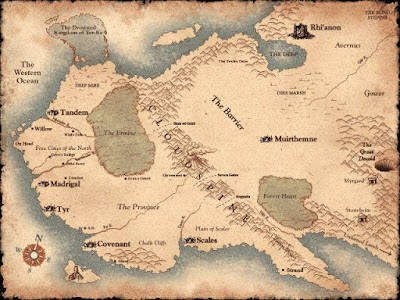
The opposition is even more varied and includes ghostly peltasts called "soulless" that float over the terrain, as well as the aforementioned fetch that can shoot lightning from their fingertips.  However, the backbone of the armies of darkness are the thrall, axe-wielding zombies basically...Stages in which the player is charged with defending a fixed position against advancing columns of these foes are by far my favorite mission type, if for no other reason than the sheer amount of on-screen carnage.  Of course planting satchel charges and creating killzones is great fun, but equally exciting is targeting the shuffling timebombs known as "wights."  Hit them with a couple of arrows and the resulting explosion, created by these bloated walking corpses, causes the ground to ripple and can kill or paralyze anything caught in the blast radius.  Some other units also have interesting secondary abilities; thrall can pass through (or hide in) deep water, archers can release flaming arrows, ghols can pick up objects on the battlefield and throw them.  As you might have noticed, the bad guys have more interesting units.  Thankfully, players do get the chance to try them out in multiplayer.

Contrary to my usual gaming habits, I did play quite a bit of Myth and Myth II online.  In part it was because of Bungie's free, easy-to-use matchmaking service (a rarity in those days).  There was also a ranking system although I never made it past the lowest crown tier.  There were also some interesting mods for the game, including a vietnam multiplayer total conversion and a developer-endorsed fan-made single player campaign for Myth II entitled "Chimera."

Despite the vast array of features offered, when I think back on the Myth series my fondest memories are of the names of each unit and the accompanying flavor text.  The game tracks kill counts in addition to the number of mission survived for each unit.  These forms of experience affect movement speed, attack rate and even hit points.  One way to make the later levels easier in Myth (aside from turning down the difficulty setting) is to make sure more units survive earlier on - thus allowing them to become veterans.  So, in a sense, each of the player's units starts to take on their own personal history and value.  The names are also evocative and reflect the culture from which that unit came.  For example a berserker might have a name like "Eirik who Jams the Gates of the Underworld," or "Tyrgeis with a Shirt of Scars," while a journeyman might have a name along the lines of "Eight Flint Deer," or "Twelve Eagle Falling Sun."  Meanwhile, swordsmen have old English sounding names such as "Duncan," "Avis," or "Owen."  One particular race of foes called the "Bre'Unor" only appear in one level, but their bone armor, flint weapons, pet wolves, monolithic shrines and nocturnal ambushes made a lasting impression on me.

The flavor text made visible by selecting a single unit hints at a much deeper and richer setting than what actually makes it on-screen.  Steve Jackson Games actually ported over the setting to G.U.R.P.S. (Generic Universal Role-Playing System), but the sourcebook was oddly lacking in details.  Particularly with regards to the cycle of light and dark.  It's a bit of a spoiler, but the setting of Myth follows a 1000 (or possibly 500) year pattern of civilization rising and falling.  The concept is kind of interesting considering the mediterranean followed a similar course with the bronze age collapse in 1177 B.C., followed by the fall of Rome in 476 A.D., and now with war in Syria, civil unrest in Egypt and a major financial crisis in Greece one wonders if this simply isn't the third time around.  Even the "Leveler" takes on a quasi-symbolic importance in that the creator of one age is the destroyer of the next.  It's all too topical considering recent matters having to do with fossil fuels and climate change.  Did Bungie intend their IP to convey that sort of allusion to the real world?  I don't know, but there's no denying its relevance even to this day.  

Wednesday, March 8, 2017

For Honor...or not

...and
que slo mo walk toward the camera
Ubisoft should really consider adding a "no" between the "U" and "play" for their peer-to-peer multiplayer service.  Not just for that service's mandatory installation requirements or the poor net code that comes with it, but because of the borderline insults For Honor waves in the faces of consumers.  It's a full priced video game with microtransactions that introduce pay-to-win elements into certain game modes.  The single player component, aside from being a decent tutorial, is pretty lackluster and the story (as many have already pointed out) is just an excuse to have warriors from vastly different times and places do battle against one another.

Of course the big question on every arm-chair duelist's lips is "who would win such a hypothetical fight?" to which the correct answer is "whichever side does the best job of maximizing their strengths while minimizing their weaknesses."  You can argue and debate forever about whether a katana is better than a bastard sword, or whether harring foes with horseback archers is more effective than a flanking charge with lancers, but the simple truth is you're quibbling over clipped copper pennies when the gold and gems here are the minds and bodies of the people equipped with all that gear.

Teacher, is this going to be on the test?
Take something as basic as sword stances; holding a sword high over the head makes downward cuts a quick way to attack, but it also tips an opponent off to your most likely move.  A middle (guard) stance puts the blade between you and your enemy making it less difficult to parry or defend against a charging attack, but also gives your opponent an easy means of gauging your weapon's reach.  Alternatively, there a low stance in which the sword tip is often aimed downward and away from an opponent.  It's the least used, generally speaking, because it provides none of the advantages of the other two stances.  However, it does make feints and other forms of deception a bit more likely to succeed.

So, which do you use and when?  It depends largely on your capabilities and those of your foe.  If there were a surefire technique everyone would use it, which would mean it's is no longer a guaranteed way to win.  One of the basic axioms of melee combat is "every attack has a counter, and every counter can be countered.

In his treatise "The Art of War," Sun Tzu wrote "all war is based on deception,"  and by extrapolating that and applying it to hand-to-hand combat we can conclude that doing something an opponent isn't able to anticipate might very well be the key to victory.  In other words, you don't become Miyamoto Musashi by doing what's expected.  Turning your back to an opponent, even for a split second is generally considered a bad idea (for obvious reasons), but I've seen more than a few UFC fights won by doing exactly that.  "Amatures!" is what many professional fencers might say not realizing that a lot of the love taps that count as hits in their sport of choice wouldn't even put a dent in the combat effectiveness of a well armored adrenaline-fulled foe.  Sure, powerful attacks are slower than a quick flick or jab, but sooner or later you got to commit; though knowing when is the best time to do so, is the tricky part.

They set us up the bomb?
You said it, pal...
Getting back to electronics entertainment, how well does For Honor do at capturing all this?  Aside from the misleading title, pretty nicely actually....obviously some compromises had to be made for the sake of the medium, it is a video game after all....but, yeah, the dueling system is great.  Too bad the rest of the game is garbage.

Oh well...maybe someday they'll make a sequel that cleans up all the issues that surround, what is at its core, one of the best approximations to date of face-to-face medieval combat.  Maybe they'll even give it a more appropriate sounding name.  Hmmm...I got it - For Justice!    

Tuesday, September 22, 2015

Under the Waves

I've been a strong advocate on this blog for representation of submarine warfare in video games, and once more I'm taking up the (underwater) torch.  In this instance I really want to push for the inclusion of subs in World of Warships.  The developers over at Wargaming have gone on record saying there are no plans for this particular addition to the game.  I personally believe they could create a new and exciting dimension to the overall experience.  To start though, I'd like to address a common criticism leveled at submarines.

A lot of World of Warships players have express feeling on the official website forums that commanding subs would be extremely boring due to the slow speed at which these boats move.  It's a valid concern, but surface speeds of WW2 submarines tended to be between the Aurora and St. Lois.  When submerged, they go about as fast as the Bogue or Langley.  So, while slow they're no worse than ships already playable in the game.  It's also important to note that sub commanders need not chase down targets, rather they can let their prey come to them.

I agree that coding U-boats (and the like) into the game engine might present some programming difficulties, but if you approach diving underwater like a destroyer's smokescreen then the challenge might be surmountable.  The key differences are a diving consumable only affects the sub itself, has a countdown timer like the repair ability, and can be countered with acoustic sounding.  Once underwater, subs depend on batteries (that run down based on how fast the boat is moving).  Sitting still allows the sub to remain underwater longer, but makes it an easy target if located.  Additionally, it's should be impossible to end a game in a victory or draw when underwater (more on that later).  The inclusion of subs would also give destroyers (and certain cruisers) an expanded role in the form of anti-submarine warfare, not to mention new weapons like the depth charge and hedgehog.

Players start with cruisers at tier 1.  From there can expand out to destroyers at tier 2, battleships at tier 3, and aircraft carriers at tier 4.  Why not add subs at tier 6?  It's at a place where destroyers start to lose their effectiveness against other surface ships.  Here's a hypothetical example:


I want to toss out a few more ideas regarding subs.  Instead of commanding a single ship, how about a single player controlling a "wolfpack" via an RTS-style tactical map similar to the one aircraft carrier commanders use.  For such a player the pace of the battle might be more of a thinking-man's game, which might not appeal to everyone, but the same can just as easily be said for carrier gameplay.  I think a couple of other restrictions also have to be applied to submarines for balance reasons.

  • First, they can't capture (or prevent the capture of) bases while underwater.
  • Second, destruction of all enemy subs isn't needed for victory (i.e. if one side loses all their surface ships then they are considered defeated regardless if they still have active subs on the map).
  • Third, there needs to be strict limits on the number of subs in a given match (2-4 at most).

Of course, submarines aren't the only thing I'd like to see added to World of Warships.  New nations and their fleets aside, minefields that offer some risk/reward in the crossing could be exciting.  Night engagements with star-shells, spotlights, and lighthouse capture points would be great.  A.I. controlled coastal defense batteries or P.T. boats would be awesome.  Adverse weather conditions that affect visibility, speed and accuracy might be interesting too. There's a lot that could be added to the game.  For me though, the number one thing remains submarines.

Wednesday, June 24, 2015

Re-imaginings of Futures Past

Remakes are all the rage these days which makes me wonder why no developer has revisited the Wing Commander franchise.  With the success of War Thunder's free-to-play model and Star Citizen's fund raising efforts, you'd think it would be a no-brainier.  Then again, it's surprising how many people have never heard of Wing Commander.

If you're not familiar with the IP, it's basically World War 2 in space.  An alien race of bipedal felines, called the "Kilrathi," are stand-ins for the Japanese while humans, or "Terrans" (as they are called in-universe), are the Americans (although their ethnic diversity reminds me of the RAF during the Battle for Britain more than anything else).  Regardless, the game is really about dogfights and fleet actions, just in space instead of the Pacific.

I won't go into great detail about how to do a remake, mostly because someone else has done an fairly good job of laying out how to go about it.  For the sake of brevity, I will try to summarize some of the ideas presented in the link provided here.

Rather than spanning over a  hundred different solar systems, the area of conflict is narrowed to a pair of neighboring stars, Sol and Proxima Centauri.  Around the red dwarf orbits a lone planet.  A thick atmosphere allows only a dim haze of crimson illumination to filter down to a tropical jungle of dark colored foliage.  This is the home of the apex predators known as the Kilrathi.  Their large stature is the result of a low gravity environment, their "cats-eyes" a natural evolutionary adaptation to the low-light conditions, geological instability has resulted in steep mountain ranges and long chains of volcanic islands which in turn has contributed to the formation of their aggressive, warlike society.

A war between two stars might sound too small compared to the vastness of the original setting, but don't forget that space (even in the limited context of our own solar system) is really huge.  It's easy to think of various planets as being roughly analogous to places of conflict during the Pacific War; Mars as Hawaii, Mercury as the Aleutians, the Asteroid Belt as the Solomon Islands, Jupiter (with all it's moons) as the Philippines, Saturn as Malaysia and the moon Titan - Saipan.  Perhaps Uranus and Neptune could be Rabal and Truk respectively.  Pluto would make a good Iwo-Jima.

Of course, the link above goes into even more detail, especially regarding the individual pilots and fighter spacecraft.  The only major thing I'd like to add is the notion of the emperor (and imperial family) being non-indigenous to Kilrah.  The Kilrathi always struck me as being far too primal to naturally develop into a space-faring race.  If their technology and organization were the result of an "up-lifting" by another enigmatic race then things would make more sense (at least to me).  It was an idea suggested in the novels, but I'd like to see it more integral to the setting.

I also think a bit more strategic input would work wonders for the setting.  Looking at the pre-alpha footage of Enemy Starfighter, it's pretty clear that a lot is being done to innovate on the space flight-sim combat genre.  Being able to switch control from one spacecraft to another could easily be justified in-universe if the player character were a remote drone pilot.

In terms of graphics, I think there's a number of improvements that can be made.  Sure, detailed textures are great, but aesthetically I'd like to see some of the sleeker designs of the earlier games, rather than the boxy shapes that came later.  Battle damage tends to not receive the attention it deserves which is why I'd love to see ship models that allow wings to get ripped off, noses smashed in, and ruptured hulls bleeding trails of vapor.

Rather than heavily scripted missions with rigidly defined objectives, it would be great to see a more dynamic framework the adjusts depending on how well the player does during sorties (think Middle-earth: Shadows of Mordor, but with capital ships rather than orc captains).  As always, I'm going to lobby for the option to fly as the Kilrathi, if for no other reason than increased replay value.  Some kind of co-op multiplayer mode or asymmetric gameplay wherein some players fly fighters while others drive capital ships would be pretty interesting too.  Oh yeah...and the obligatory traitor pilot should be decided via random algorithm.  Then, maybe I'll have a chance to kill Maniac without getting court-marshaled.

Saturday, June 20, 2015

All Hands on Deck

First there were airplanes, then there were tanks, and now finally this Russian multiplayer online game developer is arriving at the warships aspect of their World War 2 era trilogy of combat sims.  For me, this is were things get really exciting.  Sure, I love dogfights and tank battles, but my real passion is naval warfare from Tsushima to Ten-Go.  Interestingly enough World of Warships reminds me a lot of something I played long, long ago...

One of the first games I ever played was on my cousins Intellivision.  It bore the rather self-explanatory title, Sea Battle.  This might sound a bit silly but as far as second generation consoles go, the game was surprisingly deep.  Two players face off against each other among a chain of islands in an unnamed ocean.  Thirteen ships are available for deployment from each player's respective harbor.  Up to four squadrons (consisting of up to three different vessels) can be formed and while the number and position of all active ships is clear from the strategic map, the composition of each squadron is something that each player decides in secret via the the controller inputs. When two rival squadrons get close either player can choose to start an engagement at which point the map zooms in and combat begins. Ships are true to their class in that battleships are tough, PT boats are maneuverable, and submarines use torpedoes instead of guns. Additionally, torpedoes go in a set direction hitting the first thing in their way, while guns, on the other hand, have a target zone that can shoot over land or even other vessels. Sinking happens when a ship takes too much damage from either enemy fire or do to running aground. Players can choose to disengage, but must survive 15 more seconds of combat after opting to withdraw.  Otherwise, the battle ends once one side has been completely annihilated.  

Damaged ships can be repaired and squadrons reorganized at their home port (up to a total of three time per side).  Special minelayer ships can spread up to four invisible minefields that damage or destroy enemy vessels should they pass through the area.  That is, unless the other player has a minesweeper in their squadron.  Total victory is achieved by one side maneuvering either their carrier or troop transport into their opponents harbor.  In this way it's theoretically possible to win without ever engaging the enemy fleet.  Obviously if one side looses both of these strategically important vessels, victory seems impossible.  However, it's actually still a possibility.  When both the carrier and troop transport on each team has been destroyed, the game enters a "sudden death" mode whereby the first player to sail any of their surviving ships into the opposing harbor wins the game.

There's also a number of subtle touches like the speed of squadrons being affected by the slowest ship.  Minesweepers, in particular, move at a snail's pace on the strategic map while clearing out mines.  Hence, it's possible to make educated guesses as to the composition of enemy squadrons.  Weapons have different range and damage ratings depending on the ships class, and even have little details like acceleration ratings.  As you can probably guess, battleships hit hard and have a lot of range, but aren't exactly agile.  Then again some of the other aforementioned vessels are generally weak in combat, but have valuable roles when it comes to the strategic part of the game.

I can only hope that Wargaming and Gaijin Entertainment take some of the lessons of this old game to heart.  Granted, Sea Battle had certain limitations necessitated by the hardware.  Still, I think that this old game really shined at a conceptual level.  At the very least I'd like to see submarines and auxiliary ships introduced to World of Warships.  I know submariners tend to think of themselves as the "silent service," but that doesn't mean they play a less important part than other aspects of naval warfare.  Besides, if video games had combined fleets that included submarines 25 years ago, I don't think it's too much to ask for them now.