Showing posts with label modularity. Show all posts

Thursday, November 22, 2018

The Devil You Know...

You okay there, doggy?
It sounds like Bethesda Softworks is reluctant to move on to a new toolset when it comes to making games.  To some degree, I can understand where they're coming from.  If it ain't broke don't fix it...except, in this case, the engine Bethesda uses (and has used for ages) is kind of broken.

When it comes to Bethesda products, there tends to be so many glitches and bugs that a non-trivial number of them never get fixed.  Considering that it's perfectly possible to iron out these issues via downloadable updates, this sort of approach to post-launch support feels inexcusable.  Instead, the task has been handed over to unpaid mod makers.  I've heard claim that problems like these are unavoidable given the scale and scope of Bethesda's games, but I don't think that argument really holds water.  There are plenty of open-world games that do not suffer from endemic jank; Horizon: Zero Dawn and Legend of Zelda: Breath of the Wild being the two most recent examples that come to mind.  For the sake of argument though, let's say that it's a precondition of the Elder Scrolls and Fallout games that they are never going to be bug-free.  Why does Bethesda continue to use such a flawed system of game development?

Switching to a new, or seriously overhauled, engine is pretty much guaranteed to have some snags, but it hardly seems to be sacrificial when the current method is so unsound.  I guess the lead developers over at Bethesda would rather deal with the devil they know than something they don't...speaking of devils and demons...

No bugs?  When mammoths fly!
Bethesda's parent company is ZeniMax, who also shepards ID Software, makers of the DOOM series and a company famous for game engines.  One can't help wondering why some of the disciples of John Carmack don't help Bethesda forge a new framework for their future projects.  Combining the tech-savvy of ID with the world-building of Bethesda sounds like a perfect match, but then again the devil is in the details.

Engineers and storytellers rarely think along the same lines.  What sounds great for one group might very well be a huge pain in the neck for the other.  Look no further than the Destiny franchise to see an example of an engine that produces incredible visuals while simultaneously manages to be utterly tedious when it comes to scenario creation.

I can't say for certain where Bethesda truly resides in all this.  However, I am absolutely sure about one thing.  The next game that studio releases will have a laundry list of bugs.  Eventually, they will get fixed.  To what degree and by whom though is anyone's guess.

Thursday, March 14, 2013

Digital Doping

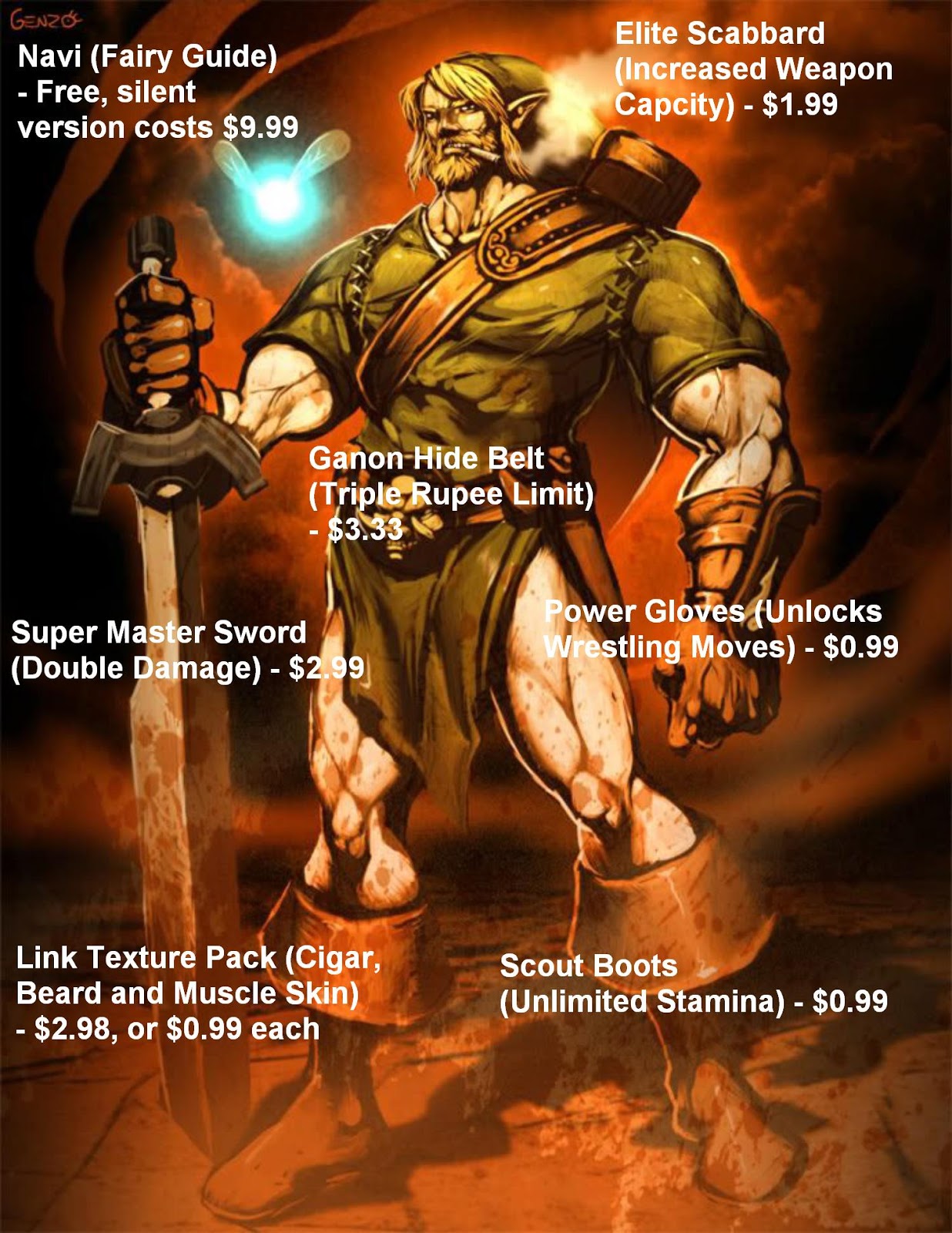
Power up for the low, low price of
$9.99 per boost!
It seems like there has been a lot of conflicting messages in the video game industry as of late.  Over on the Epic Battle Cry podcast, Daniel Kayser made an interesting observation regarding the PS4 press conference.   Specifically, he pointed out that Sony telling its audience about the benefits of connected gameplay, motion sensing cameras and dedicated hardware that does things online without your input, doesn't really jive with games like Infamous: Second Son, in which the entire premise revolves around fighting a "big brother" society.
Another aspect of gaming that is developing a similar conflict of interest is the notion of online play and micro-transactions.  Of course, the most obvious example is competitive multiplayer games where players can pay extra for perks over their fellow players, or at least bypass the time needed to earn upgrades.  It looks great from a business perspective, but has a souring effect on the player base.  Generally speaking, people who play video games want success to come to those who put in the effort, merit over money and skill over hacks.  Then again if we're talking offline gaming then who cares, right?  Well, recently there's been a big shift in the industry to make always online, always connected and always social key features.  The thing about that is I don't think the industry has really considered the way this might work against their revenue models.  Not many people want to play a game were the top dog is ultimately the one who spends the most real world cash.
To me, it feels like the end result of pushing for more and more micro-transactions is the creation of a system that offers a false sense of status.  Do we really want various video game companies to go the route of BMW, Bose, De Beer, Gap and a bunch of other trendy junk manufacturers, targeting the over-privileged and extremely gullible?  At the very least we're going to have to put up with a lot of unwanted design choices.  I don't know about you, but I'm not looking forward to seeing a bunch of Farmville hybrids, nor am I excited by the prospect of  sports games that let players artificially enhance their athletes' performance for the small fee of $X.XX in real world cash made payable to EA and their ilk.  Video game companies want to be a service-based industry, but the question a have to ask is "Who do they really want to serve here?"

Friday, October 26, 2012

Back for a Rematch


A little over three years ago I made a post on this blog about the decline of PC gaming.  You can read about it here.  I still stand by the six reasons I gave as major hindrances which keep the PC from dominating the video game industry.  That said a lot has happened, and as the current generation of home consoles grow older the PC is starting to make a comeback in a big way.  Why?  Well, here's six reasons:

1# Scale-ability.  One of the nice things about PC games is the ability to adjust the visual performance to suit your own preferences.  This can mean better than current console graphics, but on the flip side I tend to think of it as stuff like toning down resolution to get the most out of particle and shadow effects when trying to play Doom 3 on old hardware.  Consoles on the other had give you no such option.  Whatever the settings are your stuck with regardless of your priorities, which brings me to my next point.

2# Mod-ability.  Ever heard of Black Mesa Source?  DayZ?  Europa Barbarorum?  How about Day of Defeat?  These are just a few mods to come out for the PC over the years.  They're free, and many are practically complete games in their own right.  Best of all I've just barely scratched the surface of what's out there.  Not all mods are overhauls either you got everything from a duck tape mod that lets you attach that trust flashlight to your gun to improved UI.  Integrated support for modding is also becoming increasingly common which is great for less tech savvy PC users.

3# Freedom of Distribution.  You make a game for Xbox360 and your looking at licencing fees, Microsoft's tedious certification process and only one digital means of distribution.  Go with PC on the other hand and you got none of the corporate imposed hurdles, plus options like Steam, GOG and even self-publishing.  Not to mention non-standard means of funding such as community supported in-development financing like what we've seen for games such as Minecraft and Kerbal Space Program.

4# HDTV and Controller Support.  One of the costly bits of buying a PC was the need for a monitor.  Thanks to recent improvements to TV and video card support it's fairly easy to connect your PC to that big screen TV you got and while the display tends to not be quite as sharp, there are a number of benefits to this arrangement when it comes to watching video streaming.  Most new games to come out also support your standard Xbox style controller which is a huge help for certain titles which brings us to... 

5# A Mouse and Keyboard.  I don't care what anyone else says.  If your going to play an RTS, FPS or pretty much anything other than a flight-sim, mouse and keyboard is an equal or superior control scheme.  The joke is there's no reason why Sony or Microsoft can make their consoles support these input devices.  They simply refuse to do so for business reasons (In other words people who don't play video games making decisions for us gamers).

6# Bibliotheca Optimum.  I decided to give this one a Latin title in the same vein as Lingua franca.  Pretentiousness aside my point is whenever discussions come up about what is the ideal gaming platform, it always boils down to game libraries.  Well, guess what?  In terms of back catalog, free stuff, and shear variety noting surpasses the PC.  This is especially true when you consider free emulators for everything from arcade titles to obscure 16-bit Japanese imports, not to mention DOS Box.  

So, there you have it.  Of course this list makes some assumptions about proper porting and DRM (or lack there of), but when you consider that the next generation of consoles (aside from the Ouya) will probably have a high entry cost a few launch titles there becomes more and more reasons to go with a PC; better graphics, greater flexibility, more methods interfacing, less publisher bullshit, and the list goes on.  Will the PC  crush the opposition?  If Google OS gets an upgrade and Valve releases a Steam Box then absolutely.  But since neither of those things are guaranteed to happen we'll just have to wait and see.     

Tuesday, May 1, 2012

Construction Sets

There is something to be said for games which let you customize your experience.  For most titles this rarely goes farther than an arena style battle or a generic scenario with some tweaks available to the player.  However, a few game like to take this concept a bit further by letting the player craft their own adventures with the game mechanics acting as a basic framework.  Little Big Planet and Trails Evolution are probably the most famous of these kinds of make-it-yourself games, but if we look back before this generation of consoles there are a few gems to be found.  Some of them easy to use such as the Pinball Construction Set, some hard to use like the RPG Maker series, and some that simple never quite worked the way they were supposed to - Jagged Alliance: Deadly Games.  For the purposes of this blog post I want go over four construction sets that came out a long time ago...

Although its interface and graphics set are very crude by modern standards Adventure Construction Set was one of the first great game creation tools available to consumers.  It had three basic themes; fantasy, future, and modern.  Lazy designers could also use an auto-builder feature that could then be edited by the player so that they didn't have to make everything from scratch.  A pre-made adventure based on the Epic of Gilgamesh set in ancient Mesopotamia was also provided, as well as some tutorials to give the would-be-designer an idea of how things worked.  The box it came in was also unique in that it was very thin and folded out to reveal sleeve pockets for the instruction manual, data disks and reference sheets.

The Bard's Tale, The Bard's Tale II: The Destiny Knight and Bard's Tale III: Thief of Fate were a series of simple RPGs using a game engine based on the  Dungeons and Dragons table top system.  Essentially the fourth and final entry in the series (no, that 2004 title doesn't count) basically gave a polished version of the developer's tools to the fans, allowing them to make their own Bard's Tale themed levels.  Some noteworthy features included the option to create and import animated or static art from Deluxe Paint as well as the ability to fully customize monsters, items and spells.  Even the in game combat text could tailored depending on a number of variables.  Of course the developers were also kind enough to include a sample adventure for people who just wanted to slay monsters and steal treasure.

 While not nearly as robust as the previously mentioned construction kits, Tenchu 2: Birth of the stealth Assassins deserves to be mentioned simply because it was on the original PlayStation.  3D stealth action games were in vogue at the time so it's not hard to see why the makers of Tenchu would include this feature to one up the competition.  Mission building is surprisingly painless and offers a fairly impressive number of options including trap placement, differing objectives and patrol patterns for enemies.  Thanks to its intuitive nature though turning out something worth playing can be done in a surprisingly short amount of time.

The Ancient Art of War followed by two sequels with the same title plus the attached affix "at Sea" and "in the Skies" respectively were impressive in the amount of customization one could do without even messing with the map editor.  I've always had a great deal of fondness for this series simply because it got me interested in real history.  The games themselves came in rather hefty boxes with tome-like manuals which featured quite a bit of real history in addition to explaining how the games were played.  Some of the most fun I had making adventures was with this series.  The fact that the basic systems are so well grounded makes for a compelling reason to create historical "what if...?" scenarios after playing through the robust list of real and fictional battles provided with each game.  I especially liked the fact that a good commander could force his opponent to surrender without having to turn the battle into a complete bloodbath by depriving the enemy of supplies or capturing his flag.

So, there are just a few of the games that I've played that made a lasting impression on me with their create-your-story design features.  There's a lot more that I haven't mentioned like Starcraft and Heroes of Might and Magic 2.  Needless to say with the popularity of the internet these days it's odd that we don't see more games including construction sets.  Oh well at the very least the PC mod community is doing its very best to scratch that creative itch.

Thursday, January 12, 2012

If Dark Souls Had Mods...

It seems a lot of people out there really want a PC port of Dark Souls. The idea has merit, particularly with regards to potentially improving frame rate issues in places. Talk about possibly doing Skyrim style modding has me less excited though. Don't get me wrong Skyrim has some great mods it's just that the most banal stuff tends to be the most popular. So, for kicks I decided to make a hypothetical list of the most popular mods for a PC version of Dark Souls:

  • "Perky Nipples" mod for Quelaag and her sister.
  • "No Helmets" mod for Siegmeyer, Seiglinde, Ingward, Shiva of the East, and Maneater Mildred.
  • An obligatory "Lightsaber and Giant Purple Dildo Weapon" mod.
  • An "Anime and J-Pop Hair Set" mod for character creation.
  • A "Bust Size Slider" mod for Gwynevere. Note that the smallest setting is original size.
  • ...and of course the number one most popular mod would be an online hack that griefers use to invade you even when your in hollow form. Let's call it the "Middle Digit Red Orb."

Thursday, March 11, 2010

DLC & Modular Gaming

Down Loadable Content (commonly abbreviated "DLC") has become an increasingly popular addition to the gaming industry. Aside from extending the life of a particular title it also offers a chance for publishers and developers to squeeze a little more profit out of their franchises. Recently DLC has also been used as a means to combat piracy in the form of free additional content to those who purchase a game through legitimate channels. A strategy which, I might add, is much more rewarding for gamers than the restrictive and largely ineffective DRM schemes that are all too often employed.

So, based on the above DLC seems to have a definite future in the gaming industry, right? I would say "yes" under the condition that gaming companies continue to innovate DLC in ways which benefit the people who play games. Particularly, if developers take the basic concept of DLC and run with it a bit further we could see some very interesting changes in the not so distant future.

Take for example the first DLC to be released for Mass Effect 2. Put simply it adds a new vehicle to the game which for some people is a bonus and others an unwanted nuisance. The nice part is because the content is offered via DLC players can choose to include or ignore this particular part of the Mass Effect experience. I believe that this is a clever idea because much of the controversial content in gaming titles such as vehicle segments, quick-time events, side quests, turret sequences, rhythm mini games and so on tend to be the fiddly bits of gaming that players either love or hate. Such features should be offered in the form of DLC because the game can then essentially become modular in nature. Allowing players to tailor the gaming experience to their liking, albeit in a limited way.

I think it's safe to say gamers like choice so why not go one step further still and split the single player and mutiplayer experience into two separate components which can function independently of each other? Let's face it some gamers only buy games to play on-line with their buddies, other prefer to only engage in the single player experience, and there are those who like both. So, why not let each gamer pick the arrangement they like best?

Of course there are a lot of pitfalls. We've already seen them in the form of "day one DLC" and it's ugly twin "content that is already on the disk (you just pay to unlock it)." Worse yet is DLC which is buggy, under-polished or simply doesn't bring anything interesting to the game. At the very least DLC needs to be cheaper than it is now, but despite this there is the potential to allow gamers to customize their games the way they like. Modularity in gaming could offer a lot if done right. For the good of the industry let's hope there are some developers and publishers out there that figure out how to make it work.